The trouble with the 11:08 was that you could set your watch by it, which meant Cameron had stopped looking at the board.
Eleven years of the same platform at Central, the same gap between the carriage and the edge that the recorded woman warned you about, the same seat by the window where the heater never worked. You stop checking a thing once it's reliable. That was the lesson, and the 11:08 taught it to him on a Tuesday in November by leaving without him while he stood at the kiosk deciding between two sandwiches he didn't want.
He watched the tail lights go. He had a cheese and onion in his hand that he hadn't paid for yet, and he stood there long enough that the man behind the counter asked was he buying it or no.
"Aye. Sorry."
The next train was the last one. The midnight line, the conductors called it, the 11:53 that ran all the way out to the far stops where the city thinned into nothing, where Cameron lived in a flat the colour of a cloudy day. He'd never ridden it. He was always on the earlier one, home and settled by midnight, the phone propped on the pillow showing him something he wouldn't remember in the morning.
He bought a coffee he didn't want either and sat on the cold bench and ate the sandwich and felt the particular flatness of a man whose evening had been mildly inconvenienced and who had nothing larger to weigh it against. It was raining the way it rains in Glasgow, which is to say it had been raining for so long that it no longer counted as weather, only as the medium the city sat in. The platform lights buzzed. A pigeon walked under the bench with the confidence of something that had given up on fear.
The 11:53 came in slow and stopped with a long exhale of the doors.
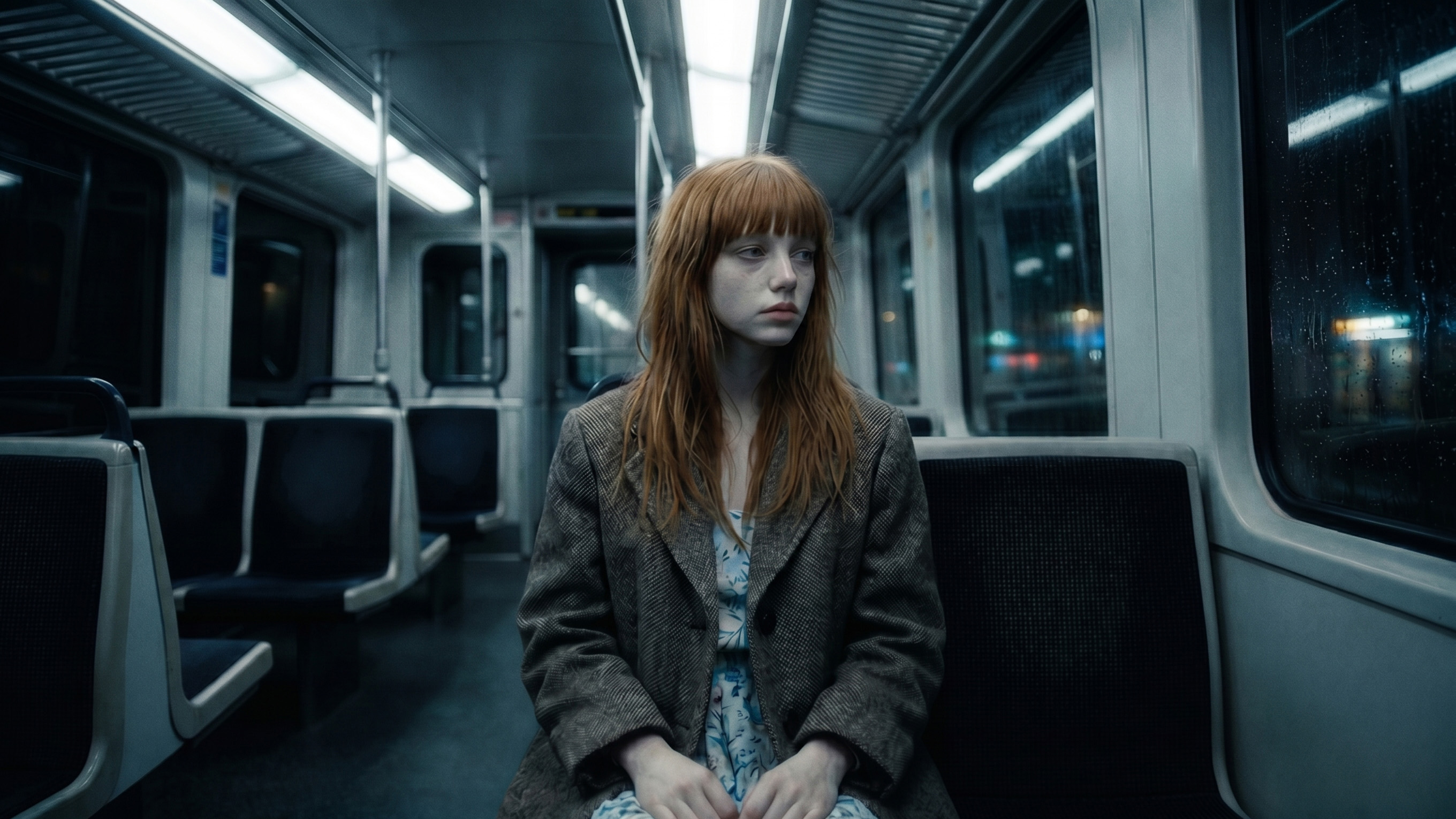
He got on the second carriage because it was nearest. The light inside was the white that makes everyone look recently deceased. The carriage was empty except for the litter the day had left, a paper cup rolling a slow arc with the train's motion, a folded Metro gone soft with damp. Empty except for her.
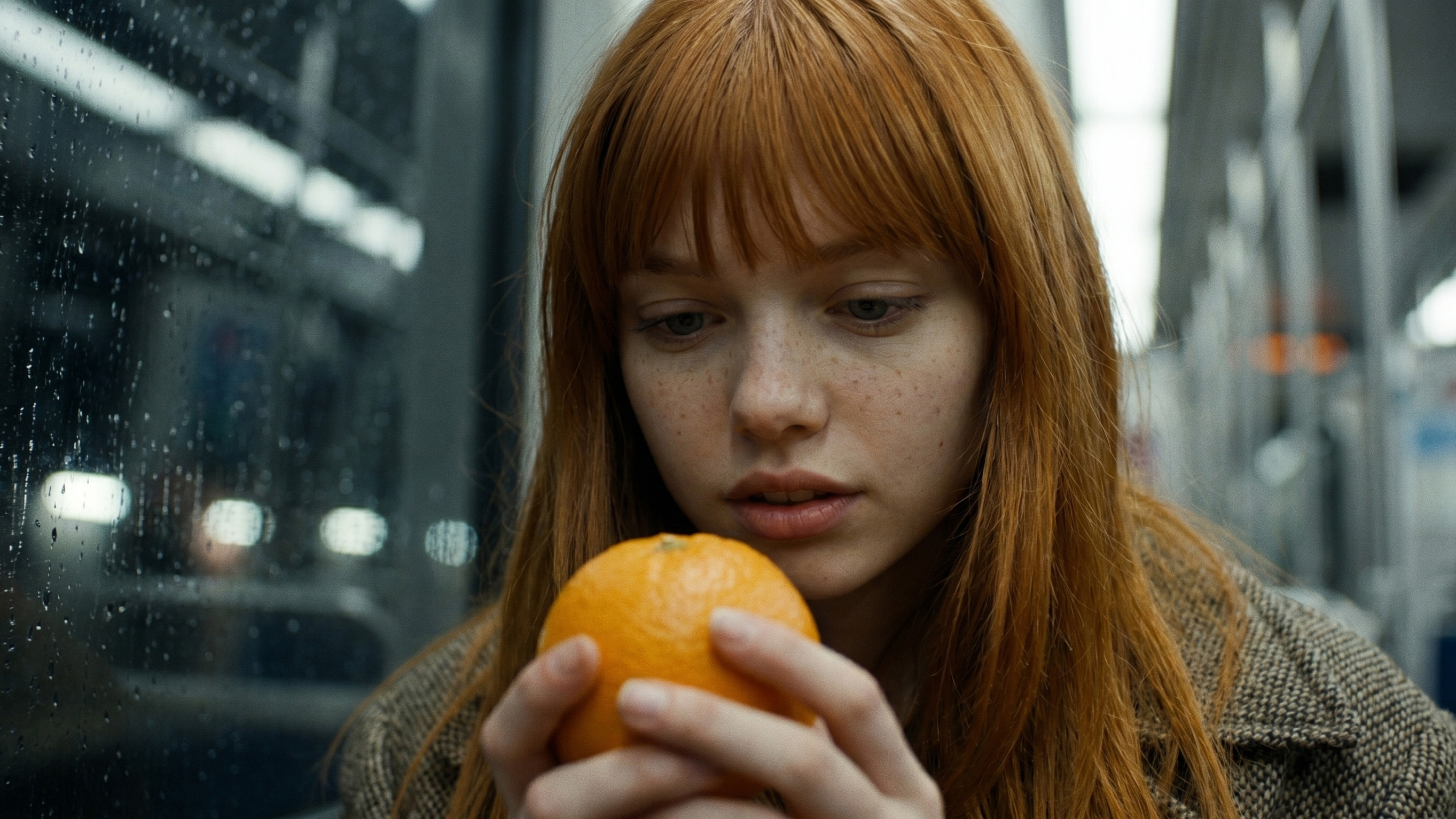
She was at the far end, in the seat that faces backward, with her boots up on the seat across, which you weren't meant to do, and she was holding an orange.
That was the first thing. She was holding an orange up to the light and turning it, slowly, the way nobody turns an orange they mean to eat. She turned it and looked at it. Then she put it against her cheek and held it there with her eyes closed, the way you'd hold something cold to a bruise, except it wasn't cold and there was no bruise, and her face while she did it was the face of someone listening to a song only she could hear.
Cameron sat down without deciding to and got his phone out and looked at it.
He didn't want to be the man. There's a man, on a late train, in an empty carriage, with one woman, and Cameron had spent his whole life being careful not to be him: the one whose attention lands on a woman like weather she has to stand out in. So he looked at his phone. The phone showed him nothing. He scrolled a feed he wasn't reading and let his eyes go, every few seconds, to the far end of the carriage, and back.
She'd started peeling the orange.
She did it the way nobody does it, in one go, the rind coming off in a single unbroken spiral that she let hang down from her hand and lengthen as she turned the fruit, watching it grow, and when it finally dropped she caught it in her other palm and looked at it sitting there coiled like something asleep. She didn't eat the orange. She separated it into segments and laid them out on the paper sleeve of the orange along the seat beside her, in a row, smallest to largest, and looked at the row.
She was, he thought, about his age. Hard to say. Red hair, long, with a blunt fringe cut straight across, the kind of red that's nearly orange itself, which maybe was why the fruit, and freckles thrown across her nose and cheeks like someone had flicked a wet brush at her. She had on a man's tweed coat far too big for her and under it a dress with a print he couldn't make out, and odd socks, one mustard, one a faded green, pulled up over striped leggings, and the boots, which were good boots, expensive-looking and scuffed to ruin. Nothing she wore agreed with anything else she wore. She looked like a woman who had got dressed in the dark from four different decades and come out the other side looking, against all odds, exactly right.
She ate the orange one segment at a time, in order, and between each one she paused, and her eyes half-closed, and Cameron understood, watching, that she was tasting it. Not eating it. Tasting it, the way you'd taste something you'd been told about for years and never had.
His stop was Crosshill.
The train slowed for it. The recorded voice said the name. The doors opened on the wet platform and the cold came in and a moment of the rain's sound, and Cameron sat where he was and watched the doors and let them close.
He told himself it was that he was tired. That he'd missed his usual and the night was already strange and he might as well see where the line went. He told himself a few things. The train pulled out and the dark slid back over the windows and at the far end of the carriage the woman in the tweed coat folded the empty orange sleeve into a small neat square and put it in her bag, and Cameron watched her do it and felt the night crack open very slightly along a seam he hadn't known was there.
Three stops later she came alive all at once.
It was as though she'd lost track of where they were. She sat up sharp, looked out the black window, looked at the strip map above the doors, and a thing crossed her face that he could only call fear, real, brief, total, and she was up and gathering her bag against her chest and at the doors before the train had properly stopped, standing too close to them, her hand flat on the glass, and when they opened she was through them and gone into the dark of a platform Cameron didn't know the name of, and the doors shut, and he was alone with the litter and the dead-white light.
He got off at the next stop and walked home in the rain. Forty minutes. He didn't have a coat worth the name and he was soaked to the skin by the halfway point and he barely noticed. He kept seeing the spiral of the rind lengthening from her hand. He felt foolish, the way you feel foolish about a thing nobody knows you've done, and underneath the foolishness, lit up and humming, something he didn't have a word for and didn't try to find one for, because finding the word might have made it stop.
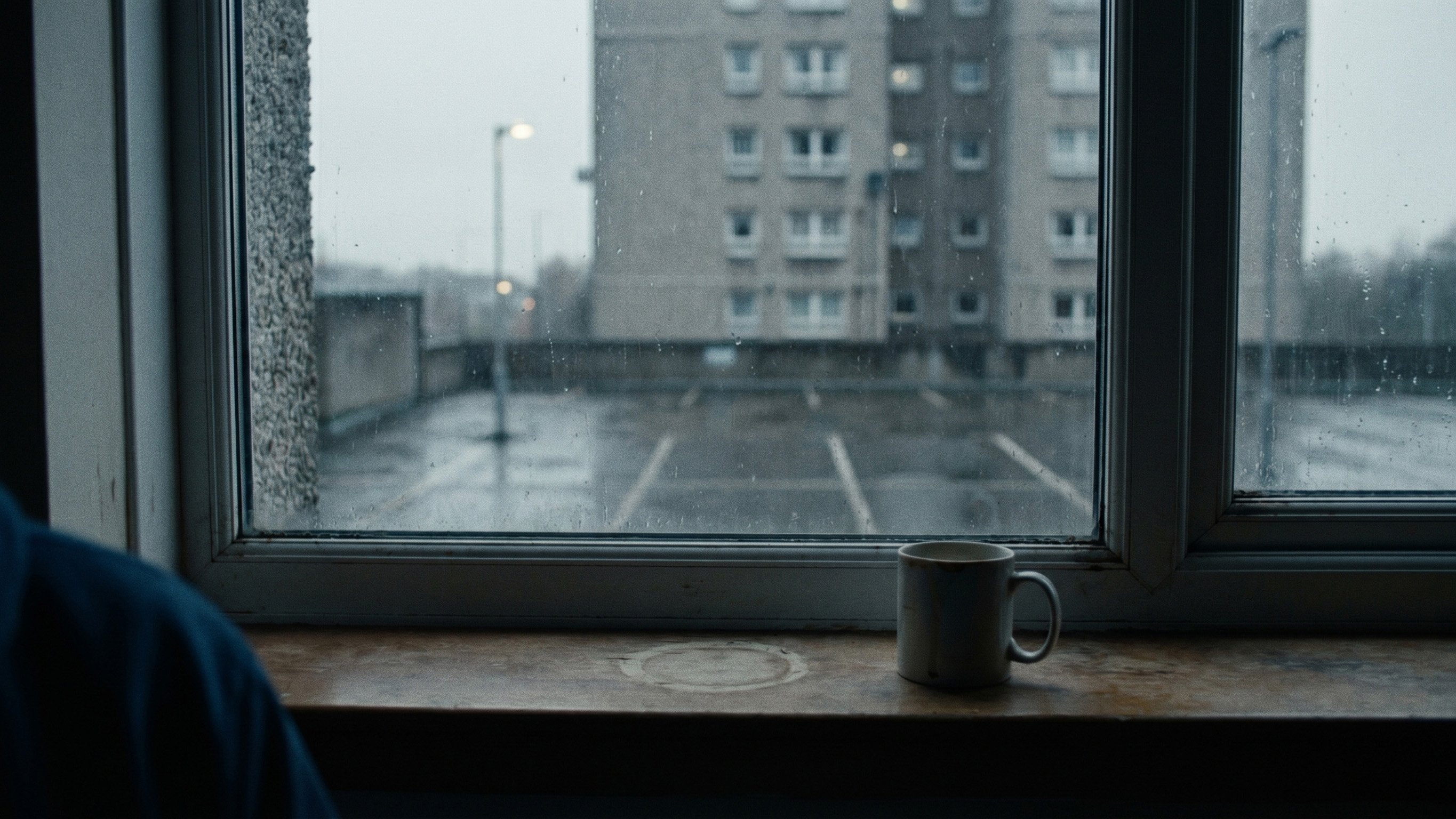
His flat was on the top floor of a four-storey block the colour of porridge. One bedroom. A window that looked onto the car park and, beyond it, the back of an identical block. He'd lived there three years. The walls were the white they'd been when he moved in, because he kept meaning to paint them and the meaning never became a Saturday.
He had a routine and the routine was good to him. He'd say that, if you asked. He got up at half six. He had the same breakfast, which was toast and the coffee from the machine his sister had given him two Christmases ago, the machine being the single most expensive object he owned and the thing he was, privately, most fond of. He went to work. He came home. Three dinners on rotation, the pasta, the stir-fry, the thing with the chicken, and he could make all three without thinking, which was the point of them. He watched things on the phone in bed. He slept fine. He'd say all of that and it would all be true and it would leave out the whole of it, which was that somewhere in the last few years the colour had gone out of things so gradually that he'd recalibrated to the grey and called it contentment.
He worked in a building near the river doing something with data for a company that did something with logistics. His job was to find the places where the numbers didn't agree with each other and make them agree. He was good at it. He had a gift, his manager said once, for spotting the thing that was off, the single wrong cell in a sheet of ten thousand, the small discrepancy that everyone else's eye slid over. Cameron had taken it as the compliment it was meant as and felt, obscurely, that it described something sadder about him than his manager intended.
He'd had a girlfriend, Rachel, for two years. It had ended eight months ago. There hadn't been a fight. There'd been a Sunday where they'd both been on their phones on the same sofa for three hours and Rachel had said, not unkindly, "What are we doing," and he'd known she didn't mean that afternoon. She moved out over the course of a fortnight, in increments, a bag at a time, and the last thing she took was a houseplant, and the soil left a ring on the windowsill that he could still see if the light came in at the right angle, which it did, in the mornings, in summer. He hadn't argued. He'd tried to think of a reason she should stay and the only ones that came were about who'd pay what, and he'd had enough self-respect not to say those out loud.
He had not, in the eight months since, been on a single date, and had not especially noticed the lack, the way you don't notice a clock has stopped until you happen to need the time.
The next morning at work he found himself, around eleven, looking at the cup of coffee on his desk, in the light from the window, the way you'd look at a thing you were trying to understand. The light had got into it and the surface was a disc of moving gold. He looked at it for a while. Then his screen pinged and he went back to the numbers, and the day closed over the moment like water over a dropped stone.
That night he left work and didn't go for the 11:08.
He told himself it wasn't on purpose. He stayed late, genuinely, there was a thing to finish. But the thing was finished by half ten and he sat at his desk in the emptying building and let the 11:08 go without him, and at half eleven he walked to Central and stood on the platform with his heart going in a way that embarrassed him, a grown man, twenty-nine years old, standing on a wet platform waiting for a train because of a woman with an orange.
She was there.
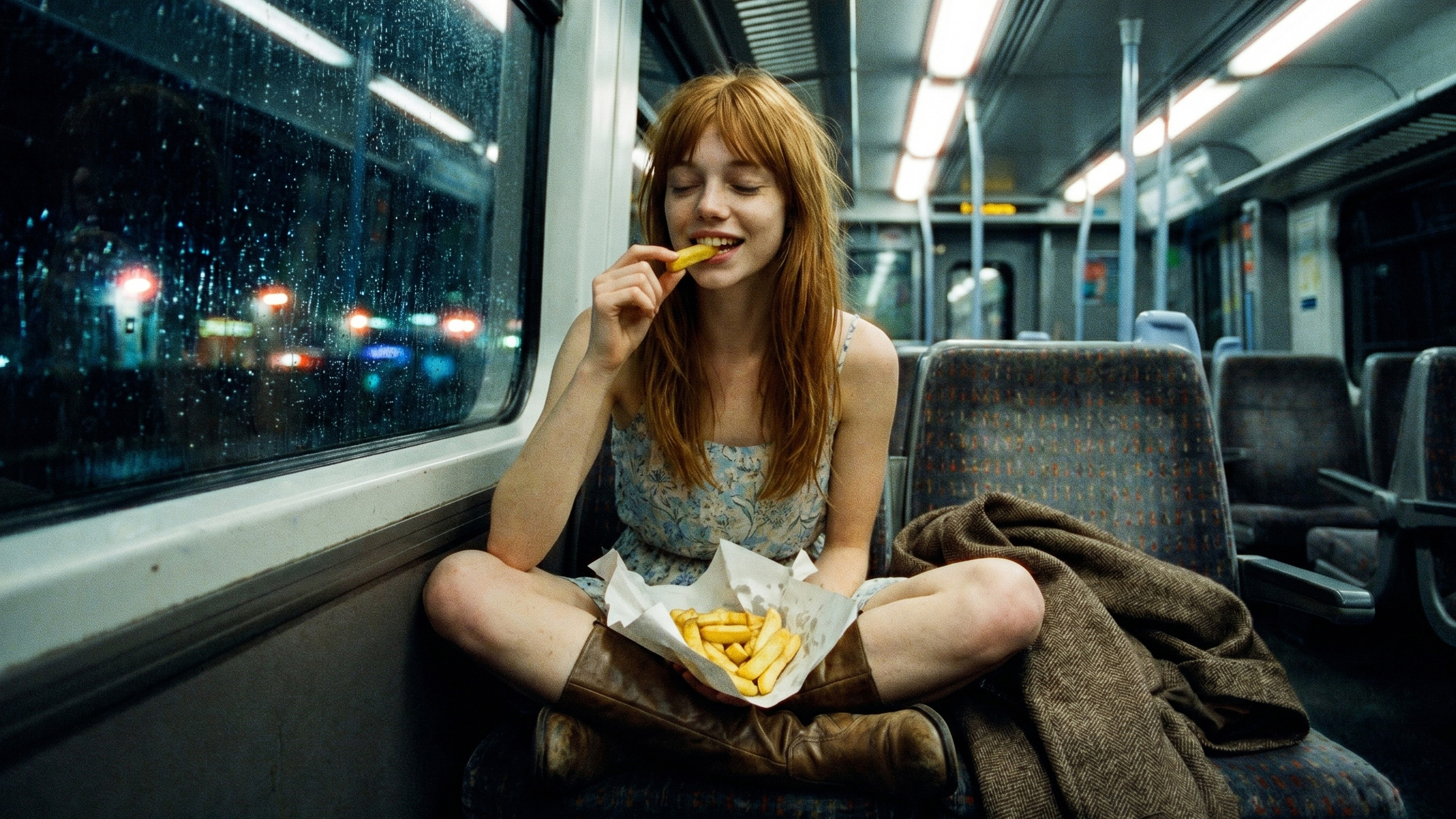
Different seat, same carriage. He'd thought about that, which carriage, on the walk over, and had hated himself a little for thinking about it. She was sitting cross-legged this time, boots off and tucked under her, and she had a paper bag of chips open on her knee, and she was eating them with a concentration that bordered on prayer.
He sat where he'd sat before, far enough away. He didn't get the phone out this time. He'd decided, somewhere, that the phone was a coward's move, and that if he was going to do this strange thing he was doing he could at least do it honestly, which meant looking out the window at the dark and letting himself look at her in the black glass's reflection, which felt less like a crime.
She ate the chips slowly. She picked each one up and looked at it before she ate it. When she got to the end she tipped the bag and poured the crumbs and the salt into her palm and licked them off, every grain, and then she folded the greasy bag the way she'd folded the orange sleeve and put it away.
The strange thing, one of the strange things, was that two lads got on at Mount Florida, drunk and loud, the way lads are on the last train, and they sat near the middle and shouted at each other about a third lad called Deek who'd apparently done something unforgivable involving a kebab and a taxi, and they did not look at her once. Cameron noticed it because he was braced for them to. He was braced to feel that thing where you have to be ready, on a late train, in case a woman alone needs someone to not-quite-stand-up. But they didn't clock her at all. They got off two stops later, still shouting, and she'd watched them the whole time with the bright still attention of a child at a zoo, and when they'd gone she let out a breath like she'd been holding it, and went back to her own world.
This time he watched her stop coming. He didn't know which one it was but he watched her, and sure enough, three before the end of the line, she did the thing, the sudden coming-alive, the bag against the chest, the fear, except this time, half-risen, she turned her head and looked straight down the carriage at him.
It lasted a second. Less. He looked away too fast, the way you do, the way that makes it worse, that turns a glance into a confession, and by the time he'd got his face arranged into the face of a man who definitely hadn't been looking, she was at the doors, and gone.
He walked home. Forty minutes. Soaked again. Grinning like a fool in the dark, at nothing, at the rain.
It went on like that for a week and a half before either of them said a word.
He learned things, watching. He learned that she always sat facing backward, toward where the train had been rather than where it was going. He learned that she ate something every time, and that it was never the same thing, and that she ate all of it with the same slow total attention, as though each meal were the only one. Chips. The orange. Once a Tunnock's teacake, which she undressed from its foil with surgical care and then turned over in her fingers studying the swirl of the chocolate before she bit it, and when she bit it and got to the marshmallow her whole face changed, and Cameron had to look out the window because the look on her face was a private thing and he had no right to it.
He learned she had a bag, a soft leather satchel, old, the strap mended with a different leather, and that she was forever putting things into it. Small things. He couldn't see what. A motion of the hand, a thing palmed off the seat or the floor and slipped into the bag, quick, like a magpie.
He learned that the fear at her stop was real and never got less. Eight nights running and it never once became routine for her, the thing that should have become routine, the way the 11:08 had become routine for him. Every night the same shock of it, as if she could not believe the stop had arrived, as if time kept catching her out.
On the ninth night she spoke to him.
The carriage was empty but for the two of them. She was eating an apple, and she'd been eating it for a long time, longer than an apple takes, and he was at his end pretending to read the damp Metro somebody had left, and she said, without looking up:
"Do you do it on purpose?"
He looked up. Her boots were up on the seat across, the way they'd been the first night. She was looking at the apple, not at him.
"Do I do what?"
"Miss it. Your stop." Now she looked at him, and her eyes were a pale blue, washed-out, the colour of the sky behind cloud just before it rains, and there was nothing shy in them at all, which surprised him. "You got on at Central the first night. You're meant to get off at Crosshill. You don't. You stay on, three more, near to the end." She took a bite of the apple, chewed, swallowed, watching him. "And then you've to get yourself home from out there, this time of night. There's no train back."
He felt the heat come up his neck. He'd thought he was the watcher. He'd built a whole little architecture of himself as the watcher, careful and unseen, and she'd dismantled it in three sentences.
"How d'you know it's Crosshill I'm meant for?"
"You stand up. Every time, at Crosshill, you near stand up, and then you don't, and you sit back down and look out the window like you meant it." She bit the apple. "Your feet know where you live even when you won't let them off."
"Maybe I just like the rain."
"Nobody likes the rain." She said it flatly, and then a small smile went across her face, the first he'd seen up close, and it changed her entirely — the striking, slightly severe face going suddenly warm and crooked, a gap between her front teeth, a freckle at the corner of her mouth he'd not been able to see from down the carriage. "That's not true. I like the rain. But you've to be daft about it the right way, and you're not daft about it. You're just wet."
He laughed. It came out of him before he could manage it, surprised, and her smile widened at the sound, pleased with herself.
"You could just sit down here," she said, "instead of away down there pretending to read a paper that's three days old. You've been on the same page for 7 minutes. I counted."
He moved down the carriage. He left a seat between them, because of the thing about being the man, and she looked at the empty seat and then at him and seemed to file the courtesy away somewhere, approving of it or amused by it, he couldn't tell.
"Cameron," he said.
"Jane."
She said it like a word she'd chosen rather than a name she'd been given, and he didn't think anything of it at the time.
"You always face backward," he said, because he'd been carrying the observation around and wanted, foolishly, to show her he'd noticed things too.
"You can see it longer that way." She nodded at the black window, at the dark streaming away behind them, the occasional light, a back garden lit by a kitchen, a fox on a wall, gone. "Facing forward you only get a thing for a second before it's past. Facing back you get it coming and you get it going. You get the whole of it." She bit the apple. "Then it's gone the same either way. But you got more of it."
He had no idea what to say to that. He looked at the dark going away behind them and tried to see it her way and got, for just a moment, a flash of it, the lit kitchen receding, a woman at a sink, the whole small unrepeatable fact of someone else's Tuesday night going by and gone, and then it passed and he was just a man on a train again.
"What's in the bag?" he said.
The change was instant and small. Her hand went to the satchel, flat on the top of it, not gripping, just covering, the way you'd put a hand over a sleeping animal so a stranger wouldn't wake it. "Things," she said.
"What kind of things?" He said it lightly, half a smile, the way you'd ask about anything.
"Just things." And she looked at him, and the look had a door in it that had quietly closed, and he was wise enough, for once, for once in his life he was wise enough, to leave it.
Crosshill came. His stop. He looked at the doors.
"Go on," she said. "Get off at your own stop for once. You'll catch your death."
"I'm fine where I am."
She looked at him a moment. Something moved behind her face that he couldn't read, that he'd spend a long time afterward trying to read, and then she shrugged and pulled her boots in closer and said, "Suit yourself," and the doors closed, and the train carried them both on into the dark.
He started to live two lives.
There was the grey one, the day one, which went on exactly as before: the toast, the numbers, the building by the river, the three dinners. And there was the other one, which began at 11:53 and lasted eleven minutes, or fourteen, or however long it was until her stop, and which had colour in it, so much colour that the day life began to look, by contrast, like a photograph of itself left too long in the sun.
He found himself, in the grey hours, storing things up to tell her. That was new. He'd go through his day and a thing would happen, the woman in the lift who pressed the wrong button and then defended it, the gull that had learned to set off the automatic doors at the Tesco and was walking in and out for the fun of it, and a part of him that had been asleep for years would wake up and say, Jane'll like that, and he'd carry it to the train like a boy carrying a frog in his hands.
And she would like it. That was the thing that undid him. She'd lean toward the story with her whole body, the way she leaned toward the food, and she'd laugh in the wrong places, the places that turned out to be the right places, and she'd ask questions about it that no one else would think to ask, what colour were the gull's feet, did the doors sound surprised, until the small dull thing he'd brought her had been turned over and held up to the light and become, in her hands, a small miracle. He started seeing his own days the way she'd see them. The grey started, here and there, to come up in colour, just from the anticipation of telling her.
She had her own stories. That became the shape of the thing, the ritual of it: he'd tell her his day and she'd tell him hers, except hers were never quite her day, never I did this, I went there. Hers were always something she'd seen. A man she'd watched make a kebab. She did three full minutes on the kebab, the spinning meat, the long knife, the precise architecture of the wrapping, the way the man's hands knew the thing so well they didn't need his eyes, which were on the football on the telly the whole time. A woman knitting on the train, days back, and Jane had watched the whole journey and tried to understand how it worked, how you could take a single long string and, with two sticks, talk it into a jumper, make a flat warm thing that held the shape of a person out of one continuous line that was, when you came down to it, just string.
"It's the making I can't get over," she said one night. She'd brought a bag of cherries and she ate them one at a time and lined the stones up on the windowsill of the train, a row of them, growing. "Things get made. All the time, everywhere, out of other things. The woman takes the string and makes a jumper. The man takes the meat and the bread and the sauce and makes a thing that wasn't there a minute ago. The whole city's just people taking what's there and turning it into what isn't. And then you eat it, or you wear it, or you throw it away, and it's done, and somebody makes another one." She put a cherry in her mouth. Her eyes were very bright. "I could watch it forever."
"You could just learn to knit. Then you'd be making the things."
She went quiet at that, and ate her cherry, and laid the stone in the row, and didn't answer, and he understood somehow that he'd said the wrong thing, or the impossible thing, though he couldn't have said why.
He learned her, detail by detail, across those weeks, without knowing he was doing it.
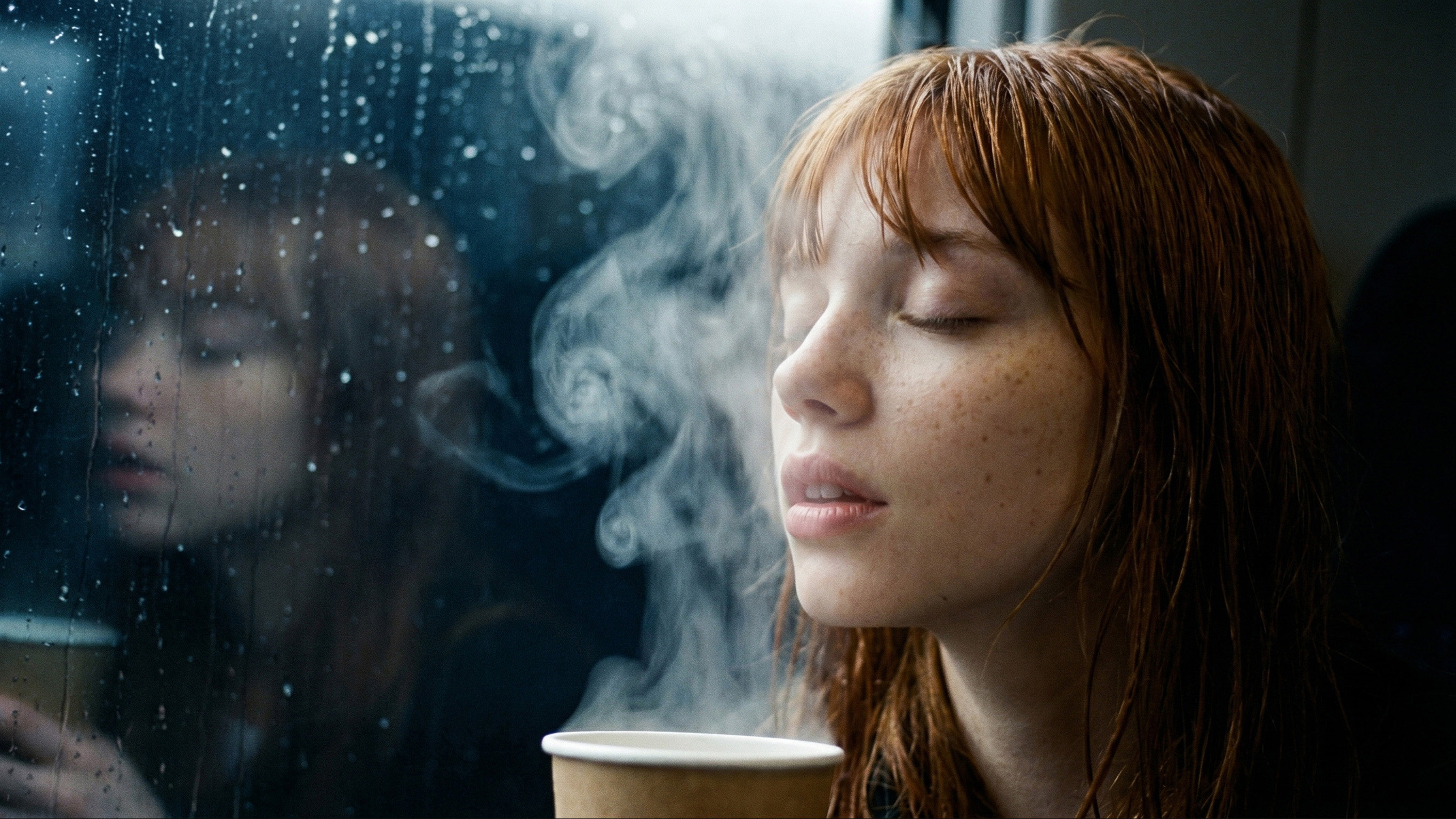
She bit her thumbnail when she was thinking, not chewing it, just resting her teeth on it and going still. Now and then a word came out of her shaped oddly, older than she was, yonder once, a word his gran might have used, and it sat strangely in her young mouth and was gone before he could ask. She couldn't whistle and was delighted by people who could. She put her cold hands flat against the train window to feel the cold and then against her own cheeks to feel them warm. When she laughed properly, all the way, she covered her mouth with the back of her hand, the gap in her teeth, as if the laugh were a thing she wanted to keep from getting out and away. She loved steam. The steam off her chips, off the coffee he brought her once in a paper cup, off her own breath against the cold window. She'd lower her face into it and shut her eyes for a second, the way you'd lean into sun. She always knew, without looking, when they were near her stop; she'd start to gather herself a minute before the slowing, like a cat hearing a key in a door three rooms away.
And she would not, ever, talk about her life.
He tried. Gently, then less gently. Where do you stay? Out the far end. What is it you do? This and that. I'm at the uni, sort of. What're you studying? Everything. I'm a slow learner. And she'd smile when she said these things, but the smile had the closed door in it, and behind the door he could feel something. Not nothing. That was the thing. He could feel a whole life back there, dense and real, she was the least empty person he'd ever met. A life she would not let him into, no matter how he turned the handle.
He built theories. He couldn't help it; finding the wrong cell in the sheet was the one thing he was good at, and her life was a sheet that didn't add up. No phone. She said she didn't have one, didn't want one, and when he'd offered once to take her number she'd looked at him as if he'd offered to take her tooth. The fear at the stop. The way she'd never let him walk her off the train, let alone home. The bag she covered with her hand. He built the theories a careful man builds. A bad boyfriend, a controlling one, the kind that checks a phone, which was why no phone, which was why home by a certain hour, which was why the fear. Or trouble of another kind, money, the law, a family she'd run from. He built them and he hated them, because each one made her smaller, and she was the largest thing in his life.
He never said any of it. He just watched the discrepancy and let it sit, the way you sit with a number that won't reconcile, knowing the error's somewhere, knowing you've not found it yet.
One night she'd been quieter than usual. She had a poke of chips she wasn't really eating, and the train was empty, and the rain was loud on the roof at the open-air stretches and then suddenly silent in the cuttings, on, off, on, off.
"I saw something last night," she said. "I keep thinking about it."
"Go on."
"There's a stair I go past." She turned a chip over and put it down. "Up the west end. There's an old woman lives on the ground floor, on her own, and every night about this time she comes out in her dressing gown and she sweeps the steps. The bit at the bottom, by the door. Sweeps them. And in the morning they're dirty again. Folk tramping through, the rain, the leaves now with the autumn. Dirty by nine. And she's out again the next night sweeping them. Same steps. Same brush." She was quiet a moment. "I watched her do it three nights running before I worked it out."
"Worked what out?"
"That it's not about the steps being clean." She looked at him. "She knows they'll be dirty again. She's not daft. She does it because — " and here Jane stopped, and her hand made a small helpless shape in the air, a gesture he'd never seen her make, reaching for a word that wasn't there. "Because it's hers to do. Because the doing of it is the thing. Not the clean step. The sweeping. She gets one more sweep. That's the whole of it, Cameron. You get the sweep. You don't get to keep the step clean. Nobody gets to keep the step clean. You just get the sweep, and then you go in, and the next night if you're lucky you get another one."
She picked up her chips and ate one, finally, looking out at the dark.
He didn't understand it, not really, not then. He thought it was a sad little story about a lonely old woman, and he thought Jane was tender-hearted, which she was, and he filed it away as another thing he loved about her without seeing the shape of what she'd actually told him. It was months later, after, that he'd take that night out and turn it over and over until he understood it.
That night he only said, "You feel things hard, don't you."
And Jane looked at him with something close to grief and said, "I feel everything hard. It's the only way I know to feel it. There's no other setting." And then she smiled, and put a chip in his hand.
He asked her to meet him outside the train.
He'd been working up to it for days, the way you work up to a thing that could end everything. He chose his words. He said it light. "We could get a coffee sometime that isn't on a train. Daylight robbery, what they charge, but I'll stand you one."
She didn't answer right away. She looked at the dark window for long enough that he started to assemble the apology.
"No daylight," she said.
"What?"
"I can't do daylight. I'm — " The hand. "I've things on, in the day. The uni. And other things." She looked at him and there was a real wanting in her face, he could see it, she wanted to say yes, and that made the no stranger. "Evening, but. A Saturday. I could do an evening."
"An evening's fine. An evening's grand."
"Not too early," she said.
He should have heard it. He'd hear it later, all of it, the whole conversation playing back with the meaning turned up like a light. But that night he only heard a yes, and the yes lit him up like a fairground, and he spent the walk home in the rain composing and discarding plans, and slept four hours, and didn't care.
She came up out of the subway at Kelvinbridge into the orange streetlight and the first thing she did was tip her head back and let the rain hit her face, eyes shut, standing dead still in the middle of the pavement while folk went round her, and Cameron stood there with the flowers he'd nearly not brought and felt his chest do something it hadn't done in years.
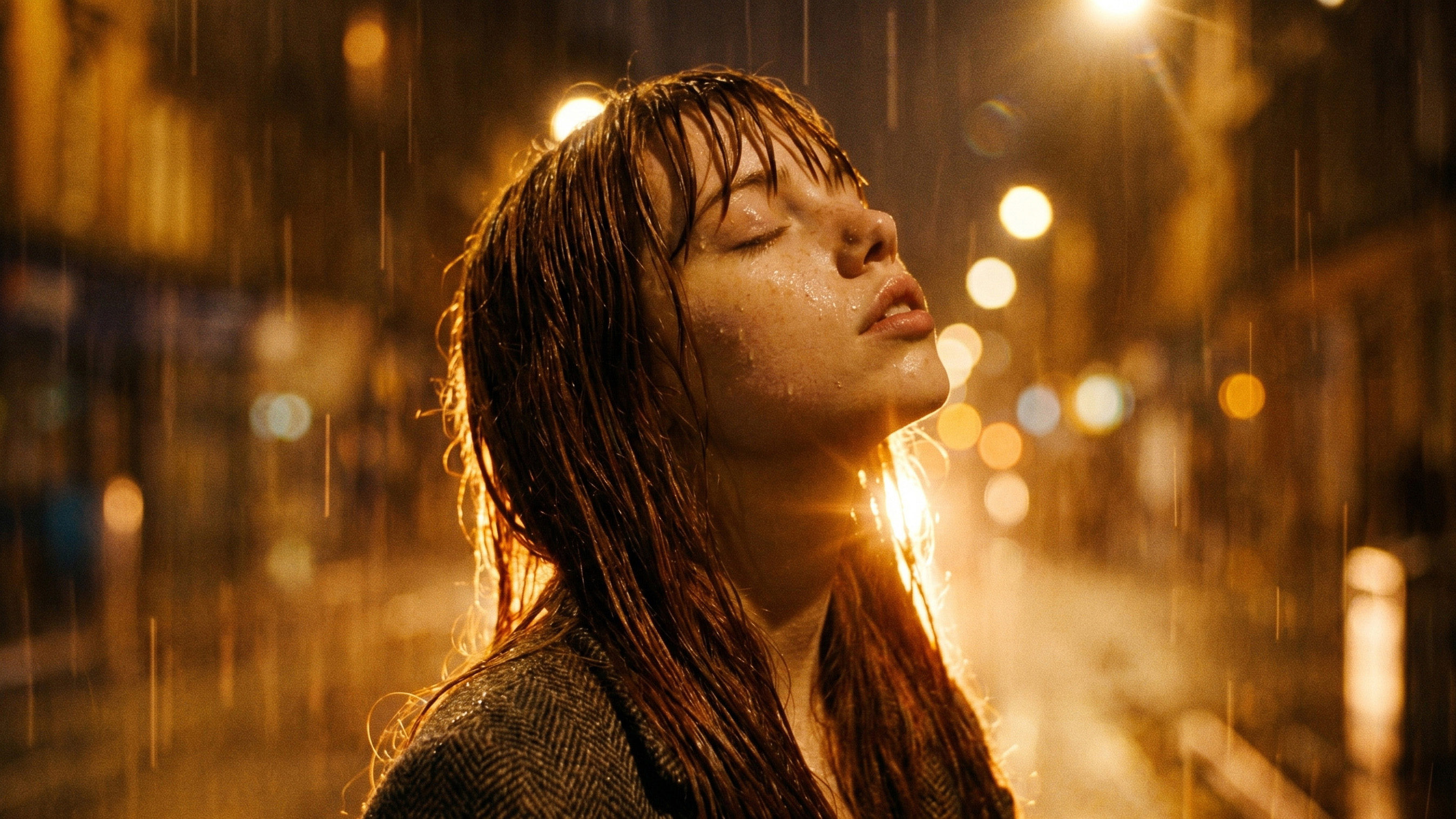
She was wearing the tweed coat and a dress the colour of a bruise healing and her hair was down and the rain was in it. When she opened her eyes and saw him and saw the flowers, just a small bunch, garage flowers, he'd panicked, her face did something he'd remember on his deathbed. She didn't say thank you. She took them and she held them up and looked into them, into the actual flowers, the way she'd looked into the orange that first night, turning the bunch, finding the centre of one of the blooms and looking right into it, and she said, "These were alive this morning in a field somewhere," and Cameron said, "They were probably in a bucket at the BP garage this morning," and she laughed, all the way, the back of her hand to her mouth, and said, "Aye, well. They were alive in a field some morning," and tucked one behind her ear and gave him back the rest to carry, which he did, like a tube of an idiot, all night, a man carrying flowers about the west end, and did not care.
They walked. She didn't want to go in anywhere at first. She wanted to walk, and he learned that night that walking with Jane was its own event, because she stopped constantly, at things, at a cat in a window that she conducted a long silent negotiation with through the glass, at a busker outside the Òran Mór packing up his guitar, whom she watched tune the thing down for its case with the focus of a surgeon, at the river off the bridge, leaning over the parapet so far he put a hand near her without touching, the Kelvin going by underneath full and brown and fast with the rain.
"There's water under all of it," she said, looking down. "Did you know that? Under the whole city. The Kelvin and the Clyde, yes, but small ones too, buried. There's a river runs under Argyle Street in a pipe. The Molendinar, under the cathedral. They're all still there, running, in the dark, under everybody's feet. The city got built on top and forgot them but they never stopped." She straightened up. Her eyes were shining. "Imagine being a river and they build a city on your head and you just — keep going. In the dark. Nobody knows you're there. But you know. You're still a river."
"How do you know all that?"
"I get about," she said, and that was all.
They ended up in a chip shop near the bottom of Byres Road because she stopped outside it and looked in the steamed-up window the way some women look in jewellers'. It was bright and steamy inside, smelling of vinegar and hot fat, a small Italian man behind the counter and a queue of drunk students. She told Cameron what she wanted and he ordered it for her, chips and a pickled onion and a can of Irn-Bru, and they took it to the Formica counter against the wall. She ate with such open, uncomplicated joy that the man behind the counter, who had seen everything, came round the counter and set a free pickled egg down on the paper by her without a word. She'd never had one. She ate it and her eyes watered at the vinegar and she said it was the best thing she'd ever put in her mouth, and the man laughed, and Cameron watched her and thought: I would set the whole grey world on fire to keep her looking like that.
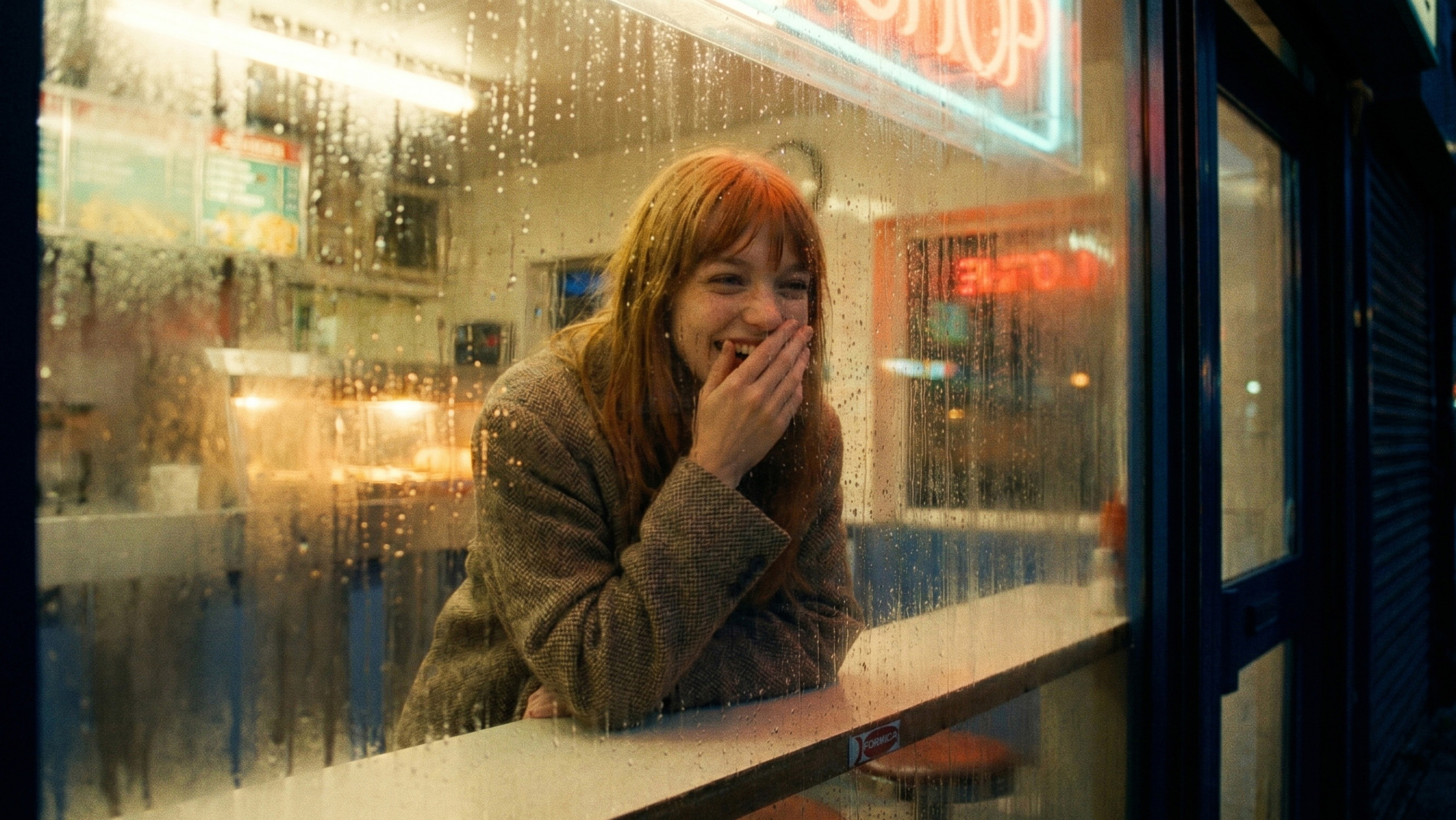
He noticed things too, though. He couldn't help it. He noticed that when the door went and two big lads came in, loud, she shifted. Not toward him, exactly. She angled herself, she put the angle of her body between herself and the room, the way she had on the train with the drunk lads, and the lads ordered their suppers and never looked at her once, and one of them, going past to the vinegar, went past close enough that Cameron tensed, and the lad's eyes went over Jane like she was a coat on a hook, no snag, no register, nothing, and were gone. And Cameron thought, good, and then thought, half a second later, with a coldness that surprised him, that's twice now. Twice that men who'd normally clock a woman like her have looked clean through her. And he put the thought down because it had nowhere to go.
He noticed she had no phone to check, all night, not once, in a year when not checking your phone all night was its own kind of miracle. He noticed she ate like every meal was being taken away from her at the end. He noticed she touched things: the cool tile of the chip shop wall, the brass rail on the bridge, the bark of a tree on Great Western Road that she put her whole hand flat against and held, for a moment, with her eyes closed, the way you'd touch the flank of a horse you knew.
At the end of the night, near her subway, she stopped him.
"This was — " She didn't finish it. She looked at him and her face was glad and frightened both. "I have to go. I'm late, near enough."
"I'll walk you to your train."
"No." Quick. Then softer. "No. I like to — I go on my own. From here." She took the flowers off him, the ones he'd been carrying all night, and held them against her chest. "I'll take these but."
"Jane."
"Aye."
He didn't know what he wanted to say. He wanted to say a hundred things and they were all too big for a pavement at midnight, so what he said was, "Same train, then. Not tomorrow, it's Sunday, there's no late train. Monday."
"Monday," she said. And then, fast, before he could do anything about it, she came up on her toes and kissed him on the cheek, near the corner of his mouth, and her lips were cold from the night and her hair smelled of rain and underneath the rain of something green, cut grass, sap, the inside of a stem, and she was gone down into the subway with the flowers held against her, two steps at a time, before he'd got his hand up to the place on his face where she'd been.
He went to the chip shop again on the Wednesday.
He told himself a reason. He'd left it, had he left something, no, he hadn't. He told himself he fancied chips. He stood outside it at half ten with the lie wearing thin and then he went in and waited for a gap in the queue and asked the Italian man, who he'd decided remembered them, remembered her, who wouldn't forget her.
"There was a lassie in last week. Saturday. Red hair, fringe, a big tweed coat. You gave her a pickled egg, on the house, mind? She'd never had one."
The man looked at him pleasantly and shook his head. "Lot of folk in on a Saturday, pal."
"Red hair. Right red. You came round the counter."
"I come round the counter for nobody," the man said, not unkindly, "or I'd never get the suppers out. You wanting chips, son?"
Cameron stood there. The fryer hissed. A girl behind him in the queue sighed. He bought the chips he didn't want and went out and stood in the rain and ate two of them and put the rest in a bin, and walked home not feeling his feet, building the explanation as he went, because there had to be one, there was always a wrong cell and you just hadn't found it: the man was old, it was a busy night, free pickled eggs were maybe not the event Cameron had made them, the man forgot, people forget. People forget. That was all. People forget.
He almost had it built by the time he got home. It held together if you didn't lean on it. He didn't lean on it. He lay in the dark and put his fingers to the corner of his mouth where she'd kissed him, three days gone, and made himself not think about the lad's eyes going through her like a window.
Monday she was on the train and the relief of it nearly took his legs.
But she was different. Dimmer, somehow. He couldn't have said how, it wasn't anything you could point at. She was paler. The freckles stood out more. She'd brought nothing to eat, the first time ever, and she sat with her hands in her lap and her bag held to her side and she was glad to see him, that was real, her face lit when he sat down, but the light had less behind it, like a bulb on a dimmer turned three-quarters down.
"You all right?"
"Tired."
"You're awful pale."
"I'm always pale. I'm ginger. We're the colour of the underneath of things." She smiled to take the weight off it. "It's nothing. Tell me your day. Tell me a thing. I need a thing tonight."
So he told her a thing, the man at work who'd brought in a cake for no reason, his own birthday, brought his own cake in and cut it and handed it round, and how strange and brave that was, to celebrate yourself out loud in an office, and she listened, and it brought some of the light back, and for eleven minutes the dimming didn't matter. But at her stop she got up slower than usual, and at the doors she put her hand on the glass to steady herself, properly steadied, a hand taking weight, and she was gone before he could ask, and he sat in the empty white carriage feeling the cold come off the night through the closed doors and not knowing what he was afraid of, only that he was.
She came to the flat on a Thursday near the end.
It was her idea, in the way that important things between them were always her idea while seeming to be the natural next step of something he'd started. He'd been telling her about the coffee machine, about how it was the best thing he owned and how his sister had given it to him and how he loved it in a way that was probably wrong, to love an object that much, and Jane had got a look, a hunger, the chips-and-orange look turned on the idea of his actual life, and she'd said:
"I want to see it."
"The machine?"
"Your flat. Where you stay. I want to see where you are when you're not here." She'd said it plainly, no edge to it, no game, and looked at him, and he'd understood that she meant it, that she wanted, with the whole of that hungry attention, to see the small grey rooms he was ashamed of, and the understanding turned something over in his chest.
"It's nothing. It's small. It's not — there's nothing to see."
"There's everything to see," she said. "It's yours."
So she came. Off the train, and this was the thing, she got off at his stop, finally, for the first time, Crosshill, where she was never bound, and the wrongness of it didn't reach him through the joy of it, and they walked the dark streets to his block and up the four flights, and he let her into the small clean flat with its porridge walls and its car-park view and its smell of him, and he stood in his own hallway mortified, seeing it all suddenly as she'd see it, the dishrack, the one chair really used out of the two, the ring on the windowsill where a houseplant had been.
And Jane walked into it like it was the Kelvingrove.
She went round it touching things. She picked up the coffee machine's portafilter and turned it over and smelled it. She opened the cupboard with the three sets of ingredients for the three dinners and looked at the neat sad order of it and said nothing, but put her hand on the edge of the shelf for a second, gently, the way she'd touched the tree. She stood at the window and looked at the car park, the rain on the cars, the back of the identical block, the one lit window in it where someone was up, and she said, "Somebody's awake over there. Look. Somebody else awake, same as us," and made it sound like the most companionable fact in the world. She found the ring on the windowsill and put her finger in it and looked at him and didn't ask, and he said, "There was a plant," and she said, "I know," and took her finger out of the ring.
She asked could she have a shower.
It came out of nothing. She'd been at the window and she'd turned round and said it, almost shy, "Could I — would it be all right if I'd a shower? A hot one?" And it was such an odd request, in the flat of a man she'd known six weeks, that he should have wondered at it, and didn't, because she'd asked it the way a child asks for a thing it's sure it'll be refused, and he could no more have refused her than stopped the rain.
"Course. There's — I'll get you a towel."
He gave her the good towel, the one guests never came to use, and he heard the water go on, and then he heard, through the door, a sound he didn't have a name for, a single sound she made when the hot water hit her, and he stood in his own front room with his heart going and made himself not picture it, and failed.
She was in there a long time. Twenty minutes. Twenty-five. He thought, once, of knocking, was she all right, and then heard her humming something through the noise of the water, tuneless, happy, the sound of a person who had gone somewhere good and not come back yet, and he left her, and put the kettle on for no reason, and stood in his kitchen more frightened and more alive than he had ever been in his life.
She came out in his towel with her wet red hair dark and slicked and her face scrubbed pink and the freckles like sparks on it, and she was warm, you could feel the heat coming off her across the room, and she was laughing because the mirror had fogged and she'd drawn a face in it with her finger and the face had started to weep as the steam ran, and she came and stood near him in the kitchen with the steam still rising off her skin and the smell of his own soap on her made strange and good, and she was saying something about how he'd no idea, he'd just no idea, that you could turn a tap and the rain came out warm, that somewhere a thing he never thought about was heating water for him while he slept, and her eyes were wet and bright with the wonder of it and she was so close and so warm and so impossibly, singularly herself that Cameron stopped hearing the words.
He kissed her.
He moved without deciding and put his hand to her warm wet cheek and kissed her, and for a second — for one second — she kissed him back, she came into it, her cold-no-longer mouth, the green smell, her hand coming up to his chest —
And then she went rigid and turned her face away and stepped back, out of his hands, her own hand flat against his chest now holding him off, and the warmth went out of the room like a door had opened on the night.
"I have to go."
"Jane — "
"I have to go. I'm sorry. I have to go, I've left it too late, I — " She gathered her clothes up against herself and backed away, into the hall, out of the light, and he heard rather than watched her pull the dress on in the dark of it, and that small turning-away undid him as much as anything. Her face when she came back into the doorway was stricken, not cold, that was the thing that gutted him, she wasn't angry, she looked bereft, she looked like a woman being marched away from a fire. "I shouldn't have come. This was — I shouldn't."
"Did I — Christ, Jane, if I read it wrong I'm sorry, I won't — "
"It's not that." She had the coat in her hands now, pressed to her front. She looked at him, and for a moment she let him see the whole of it, whatever it was, the thing behind the door, except he still couldn't read the language it was written in. "It's the opposite of that. That's the — " The hand, the helpless shape in the air, reaching for the word. "That's the trouble." She was at the door. "Don't come down after me. Please. Stay in the warm."
And she was gone, out the door and down the four flights, faster than he could follow, and by the time he was on the street in his shirt in the rain there was no sign of her in either direction, just the orange streetlights and the parked cars shining and the sound of the rain on everything, and a man standing in it in his socks, having got, somehow, everything wrong, in a way he could not begin to name.
She wasn't on the train the next night.
Or the next. Or the one after.
He told himself things. She was embarrassed. She was giving him space. She had the bad boyfriend and he'd found out. She was ill — she'd looked ill, that last dimming week, she'd looked ill and he'd told himself she was just tired. He cycled the theories and none of them held and all of them were better than the cell he wouldn't look at, the one at the very bottom of the sheet, the lad's eyes going through her, the chip man who'd never seen her, the no phone, the no photo, the no daylight, the river running in the dark under everybody's feet still being a river though nobody knew it was there.
He looked for her. He took the midnight line every night and rode it to the end and back. He got off at the stop where she got off, he'd learned which one it was, finally, by getting off with her in his mind a hundred times, and he stood on the dark platform and looked at the streets it fed and didn't know which way she'd have gone. He went up the west end on the Saturday and walked the route they'd walked, the bridge, the chip shop, the tree on Great Western Road, and put his own hand on the bark where she'd put hers and felt nothing but cold wet bark. He hung about Kelvinbridge subway like a ghost. He went to the university and stood in the quadrangles among the actual students feeling forty years old and mad, looking for a red head, a tweed coat, asking nobody because what would he ask. He missed work twice. His manager said was everything all right and he said aye, fine, family thing.
He began, in the small hours, to wonder if he'd made her up. Not really. He wasn't gone in the head, he knew she was real, he had the memory of the cold of her mouth and the green smell and the gap in her teeth. But there were no edges to her. There was no proof. A person leaves edges in the world. A person has a phone that pings, a photo somebody took, a pal who knows them, a flat with their name on a buzzer. Jane had walked through six weeks of his life and left no edge at all, nothing he could hold up and say, see, she was here, I didn't dream her. Nothing but a kiss on the corner of his mouth and a ring of soil on a windowsill that had been there before her anyway.
She came to the door a week after that.
He'd given up on the train by then. He was in, half ten, the telly on for the noise of it, and there was a knock, soft, and he opened it and she was on the landing in the tweed coat with the rain still on her, and for a second he couldn't get his breath.
She looked ill. That was the only word he had. Thinner than a fortnight could account for, the freckles standing out dark on a face gone the colour of skimmed milk, and there was that quality to her he'd see again at the end and not let himself name now, a thinness that wasn't only the body, as if some of her had been left somewhere and hadn't come back. She held the doorframe with one hand. She was smiling at him, and the smile was real, but it cost her something to hold it up.
"I couldn't stay away," she said. "I tried. I'm rotten at it."
He brought her in. He didn't ask the questions, the weeks of questions, because the look of her drove them clean out of his head and left only the wanting to make her warm. She stood in the middle of his front room dripping and looked at it, the porridge walls, the one chair, the ring on the sill, the way you'd look at a place you'd been thinking about for a while, and she put her hand flat on the back of the chair, gently, the way she put her hand on everything, like she was checking it was real.
"Can I — " she started.
"There's the towel. I'll put the water on."
She had her shower. He stood in the kitchen and heard the pipes go and then heard, through the wall, the small sound she made when the heat hit her, and this time it wasn't a sound he had to make himself not picture, it was a sound that broke his heart a little without his knowing why, the sound of someone who had come a long way for a thing this small.
She came out in his towel with her wet hair dark down her back and some of the colour back in her face from the heat, and she was warm again, you could feel it across the room again, and she came and stood near him by the window where the one light burned in the block across the car park.
"That man's still up," she said. "Over there. Same window."
"Different night. Probably a different man."
"No." She looked at it. "Same one. Some people just can't sleep." She turned from the window and looked at him and the smile had gone and something else was in its place, and she said, "Cameron. There's a thing I have to tell you. I've been trying to tell you the whole time and I can't find the — " The hand came up, the helpless shape in the air, reaching. Her eyes were wet. "There isn't a word for it. In your language or mine. I've looked. I've had a long time to look."
"Then don't," he said. "Whatever it is. You don't have to tonight."
"I do, but. That's the — " The hand again, dropping. "You'll mind me wrong, after, if I don't. You'll think it was something you did."
"Jane."
She looked at him a long moment, the wet eyes, the gap in her teeth caught behind her lip, the whole of her there in front of him and warm and going, and whatever the word was she'd been reaching for, she gave up reaching for it.
She crossed the small space between them and kissed him.
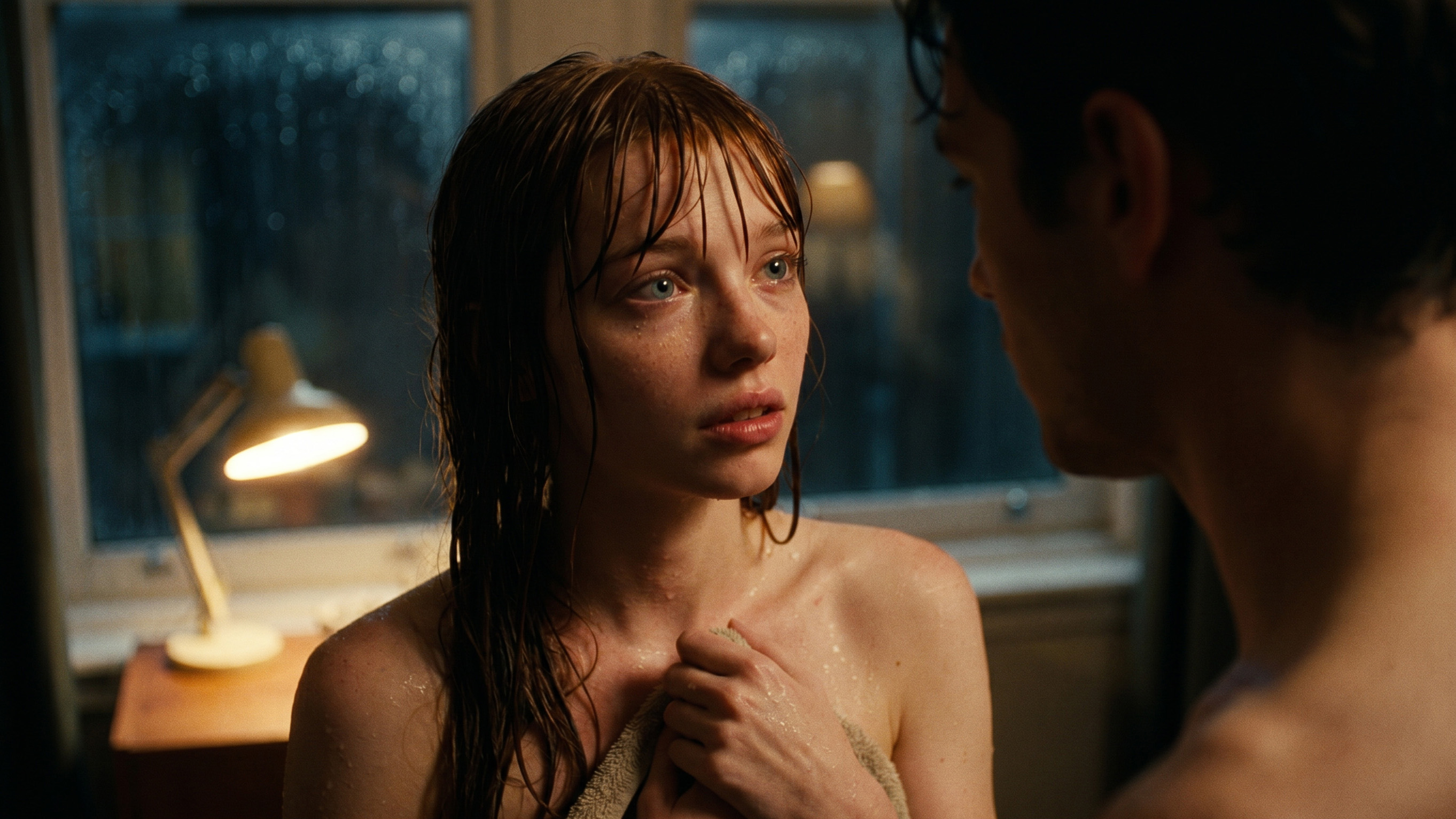
Not the cold careful kiss on the cheek of the first night. Not the kiss she'd stopped, the one she'd stepped back from with her hand flat on his chest. This one she walked into with her whole self, both hands coming up to his face, the towel-warmth and the green smell and the rain still in her hair, and there was no door behind it now, none, it was just her, deciding, taking the one thing she had not let herself take, and he understood without any words that she had stopped fighting something, and he did not know what, and it did not matter, because she was kissing him and the grey was gone out of the world entirely and what was left was so bright he could hardly bear it.
"Stay," he said, against her mouth. "Whatever it is. Stay."
She didn't answer that. She kissed him instead, and her hands found the buttons of his shirt, and the rain came down on the window and the one light burned across the car park and she took him by the hand and the night closed warm around the two of them.
He woke at first light and she was gone.
No note. There was no paper she'd have used and no hand she'd have written it in that he'd have understood. The towel was folded on the chair, squared off at the corners the way she folded everything, the orange sleeve, the chip bag, the foil. The flat smelled of his own soap and underneath it, faintly, fading even as he chased it, of cut grass, of sap, of the inside of a stem. The window across the car park was dark. He lay in the grey light and put his hand on the cold side of the bed and felt the fear come up in him that he'd felt at her stop, the time-running-out fear, except now it was his.
Then, a handful of nights later, she was on the train.
He nearly didn't see her. He'd stopped, by then, expecting to. He'd got on at Central out of habit grown grief-shaped and sat down heavy and the train had pulled out and he'd looked up and she was at the far end, facing backward, in the tweed coat, and the sight of her went through him like a current.
She was worse. That was the first thing, before the joy could even land. She was so much worse. Thin. Pale past pale, a paleness with grey under it, and there was a quality to her he'd never seen, a translucence almost, as if the white light of the carriage were getting through her in a way it shouldn't, as if she were a thing the light had started to ignore. She had nothing to eat in her hands. Her hands were just lying in her lap, and they looked older than her hands had looked.
He went down the carriage too fast.
"Where've you been?" It came out wrong, loud, the weeks of it behind it. "Jane. You came to my flat. You — and then I woke up and you were just gone, no word, nothing, and then nothing, for days, where have you been?"
"Cameron." Just his name. Tired.
"I went to the chip shop." He was standing over her and he made himself sit, made himself get level, but the thing was coming up out of him now and he couldn't stop it, weeks of the wrong cell, the unreconciled sheet, the not-knowing eating him from the inside the way she'd once said her hunger ate her. "After. I went to the chip shop where we were, and the man had never heard of you. Never seen you. Red hair, the egg, the whole thing. Nothing. And the lads in that chip shop looked through you, Jane, I saw it, more than once I've seen folk look at you like you're not there. And you've no phone and you won't let me take your picture and you can't do daylight and you near die of fright every night when your stop comes and you came to my bed and you still won't tell me one true thing about where you go or what you are or — "
"Don't." Quiet. She'd gone very still.
" — and I can't do it. I can't keep — I've turned myself inside out, I've gone half mad looking for you, I missed my work, I stood in the uni like a — and I don't even know if any of it's real, I don't know if you're — what are you not telling me? What is it? Just tell me. Whatever it is. A boyfriend, the polis, you're sick, you're in trouble, I don't care, I'll help, just tell me, because I can't keep loving somebody that won't let me — "
The word was out. He heard it land. Loving.
She turned her face to him and there were tears standing in her eyes, not falling, and her face was so sad and so kind and so far away that it stopped him dead, the thing in him that was erupting, it just stopped.
"You have to get off the train," she said.
"Jane — "
"This is your stop. Crosshill. Look." The train was slowing. The lights of the platform were coming up in the windows. "Get off, Cameron. Please. Get off the train."
"No. No, I'm not — we're talking, for once we're actually — "
"There's people." Her voice cracked. "Cameron. Look. There's people. You're frightening them."
He looked. He hadn't heard them get on — when had they got on — but there were others in the carriage now, a man with shopping, two women together, a young fella with headphones, and they were all looking at him, all of them, with the careful sideways look people give the man on the late train who's leaning over a woman and won't stop talking and has raised his voice, the man a woman might need someone to not-quite-stand-up for. He saw himself in their faces. He saw exactly the man he'd spent his whole life being careful not to be, and he was him, he'd become him, here, now, on the midnight line, and the woman he'd become him over was sitting white and shaking and telling him please, please get off the train.
The doors opened.
He got off.
He stood on the platform in the rain and the doors closed and through the wet glass he saw her put her face in her hands, and the train pulled out, and was gone into the dark, facing away from him, getting more of it, the going as well as the coming, the whole of it, until there was nothing left to get.
The next night he ordered a taxi to her stop.
He didn't let himself think about it as a decision. He thought about it as a sum. He had been a man who'd had everything taken and been given no reason, and there was a wrong cell in the sheet, and he had found, in all his life, exactly one thing he was good at, which was finding the wrong cell, and he was going to find it now if it cost him the last of whatever he had left. That was the sum. He didn't look at the other sum, the one that had a word for a man who follows a woman in a taxi to a dark stop she'd begged him to leave her at.
He had the driver let him off short of the station and he waited in the dark across the road, in the doorway of a shut unit, with the rain coming down, and he watched the platform exits, and when the midnight line came in he watched her come down the steps.
She was barely there.
She came down the steps slow, holding the rail, a small bent figure in the big coat, and she set off away from the lit streets, not toward the houses but the other way, toward the edge, where the pavement gave out and the road ran on between dark fields and a black mass of trees, and Cameron followed at a distance with his heart going and his phone in his hand.
He took the photo on the road. He told himself why as he did it, proof, he needed proof, that she was real, that he hadn't dreamt her, one photograph, was that so much, after everything, and he lifted the phone and got her in the frame, the small figure from behind, the coat, the hair gone dark with the rain, the trees ahead of her, and he pressed the button, and the phone made its small false shutter sound into the wet night.
She didn't hear it. Or she did and was past caring. She walked on, off the road now, onto the grass, toward the trees, and he came after her over the wet ground, slower, hanging back, into the dark under the branches where the rain came down in big slow drops off the leaves instead of straight, and there in the middle of the copse was the oak.
It was enormous. He'd never seen a tree so big. It stood by itself in a clearing with the others ringed back from it, and its trunk was wider than a car and its branches went up and out and lost themselves in the dark and the rain, and the moon was somewhere behind the cloud throwing a thin grey light that found the clearing, and Jane walked across the wet grass to the great oak and put her hand on the trunk.
And her hand went in.
Cameron's breath stopped. Her hand didn't rest on the bark. It went into it, into the wood, up to the wrist, and she leaned, and her arm went, and her shoulder, and the side of her, the coat, the wet red hair — she was going into the tree, half of her gone, the bark closing round her like water round a wading thing, soundless, gentle, and there was no horror in it, that was the thing that undid him, there was no violence in it at all, only a kind of homecoming, a body returning to the one place it fit.
He exhaled.
It was the smallest sound. Breath. The breath of a man whose mind had just come apart. But the clearing was so quiet, just the soft fall of the heavy drops, that it carried, and Jane heard it.
She turned.
She was half in the tree, half out, her face and one shoulder and one arm still in the world, the rest of her gone into the wood, and she turned her head and saw him crouched in the dark at the edge of the clearing with the phone still in his hand, and her face —
Her face was only sad.
Not afraid. Not angry. Not caught. Sad, the way you're sad at a thing you knew was coming and hoped against, sad the whole way down, sad for him and sad for herself and sad for the thing that could not, ever, have gone another way. She looked at him across the wet grass and the rain came down between them off the leaves and her face said the thing the door had always been in front of, said it plain at last, in the only language she had left, which was her face: I'm sorry. I'm sorry. There was never a way to tell you. There was never a way for this to stay.
And then she was gone.
The bark closed. The last of her went into the wood, the sad kind face, and the tree stood there in the rain exactly as it had stood for three hundred years, vast and dripping, with no seam, no mark, no door, nothing to say that anything had ever come or gone.
He ran to it. He put his hands on the trunk and pushed, beat on it, said her name, dug his fingers into the cracks of the bark and pulled, and it was a tree, it was only a tree, cold and wet and immovable and three hundred years old and utterly shut, and his hands came away with bark under the nails and he stood there with the rain coming down and his palms flat on the trunk the way she'd held her palms flat on the train window, feeling the cold of it, and he looked up into the dark branches and there was nothing, there was rain, there was a tree.
He took the phone out with his hands shaking and looked at the photo he'd taken.
The road. The streetlight. The rain. The black mass of the trees ahead.
No one on it.
An empty road in the rain.
Her bag was on the grass.
She'd dropped it. In that moment of turning, of seeing him, her hand had opened and the satchel had fallen, the old soft leather, the strap mended with the other leather, and it lay at the foot of the oak in the wet grass where the great roots came up out of the ground.
He picked it up. It was the only thing left in the world with her in it. He held it for a while in the rain, not opening it, the way you'd hold a thing you knew would be the last of someone, and then he sat down on the wet root of the tree with his back against the trunk that had taken her, and he opened the bag.
Inside was a tin.
A battered old tin, the kind sweets used to come in, the lid gone its own colour with handling, dented, the picture on it worn away to ghosts. He held it in both hands. He'd asked her about the bag once and she'd put her hand over it and he'd let it go. He took the lid off.
It was full of small things.
A ticket stub, a train ticket, the midnight line, a date on it from six weeks back, the first night, soft at the edges from being carried. A receipt from the chip shop on Byres Road, the chips and the onion and the Irn-Bru, faded already. A single foil wrapper, a Tunnock's teacake, folded into a small neat square. A cherry stone. A button he didn't recognise. A flower, pressed flat and brown now, garage flowers, alive in a field some morning. A square of orange peel gone hard. A leaf. A second leaf. A scrap of newspaper, a corner, no reason to it he could see. A pickled-onion-crisp packet folded small. A guitar plectrum she must have lifted off the pavement outside the Òran Mór while the busker packed up. Small things. Ordinary things. The things a person drops and never thinks of again, that mean nothing, that are rubbish, that get swept off a step and binned, the leavings of moments that come and go and don't come back.
She had been keeping them. That was all he understood at first, sitting with his back against the tree in the rain. Just moments, once and gone. She had a whole tin of them.
At the bottom of the tin, under all of it, folded twice, was a scrap of paper.
He took it out with two fingers and unfolded it in the rain, shielding it with his hand, and on it, in pencil, in letters that didn't sit quite right, letters that had been copied rather than taught, drawn the way you'd draw a shape in a language you couldn't read, was one word.
His name.
Just his name. Cameron. The C made twice, you could see, the first one given up on and done again. His name, kept under the ticket and the foil and the flower, the one thing in the tin she hadn't found on the ground. The one thing she'd had to make. He had gone in the bag with the orange peel and the cherry stone, kept, the way she kept everything she couldn't hold on to.
He sat under the tree in the rain for a long time with the tin open in his lap and the scrap of paper in his hand and the bag empty beside him, and the rain came down off the leaves in big slow drops, and somewhere under the wet grass, under the field, under the whole dark sleeping edge of the city, the buried rivers ran on in the dark the way they always had, the way they always would, still running, though nobody knew they were there.
He takes the midnight line now.
Not every night. He's not gone in the head. But once in a while, on a wet night, he finds himself at Central at half eleven, and he buys a coffee he doesn't want, and he gets on the second carriage, and he sits in the dead-white light among the litter of the day and faces backward, the way she taught him, so he can see the dark coming and going both, the lit kitchens, the foxes on the walls, the whole streaming unrepeatable world going past and gone.
The tin's in his coat pocket. He doesn't open it on the train. He just likes the weight of it.
The doors open at her stop. Nobody gets on. He looks out at the dark platform and the rain on it and the empty seat facing him, and he waits the few seconds the train waits, in case, knowing there's no in case, and then the doors close with their long exhale and the train pulls out and carries him on toward the far end of the line where he lives, in a flat that has, this last while, very slowly, here and there, begun to come up in colour. A thing on a wall. A second chair. A plant on the sill in the old ring. The way a room does when the light comes back into it by degrees too small to notice, until one morning you look up and it's there.
He opens the tin then, at the end of the line, alone on the platform, and looks at the things inside. The ticket. The foil. The flower. The cherry stone. The scrap with his name on it in her copied hand.
He closes it.
The train goes back the way it came, empty, facing away, and he stands and watches it go until he's got the whole of it, the coming and the going both, and then there's nothing left to get, and he walks home in the rain.

Commission your own 7K masterpiece!
I've recently reopened commissions.
Get your own softcore or hardcore 7K artwork, or 2K softcore or hardcore video, plus a brief story to accompany it.
The queue is filling quickly, so grab your place early!